news
Triple mower is light on delicate lucerne
------
Read the full article below from the farmers guardian, July 2023…
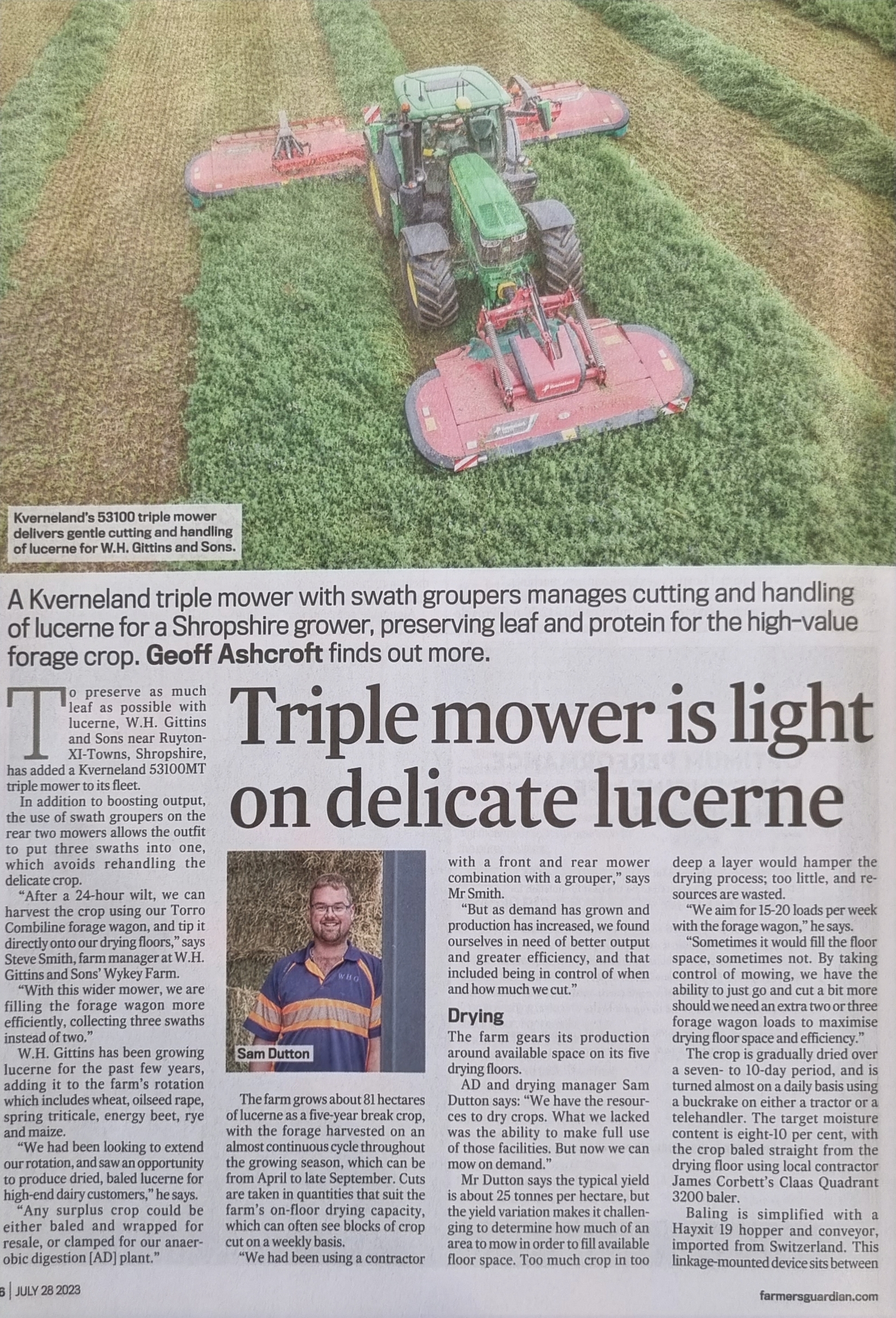
A Kverneland triple mower with swath groupers manages cutting and handling of lucerne for a Shropshire grower, preserving leaf and protein for the high-value forage crop. Geoff Ashcroft finds out more.
To preserve as much leaf as possible with lucerne, W.H. Gittins and Sons near Ruyton- XI-Towns, Shropshire, has added a Kverneland 53100MT triple mower to its fleet.
In addition to boosting output, the use of swath groupers on the rear two mowers allows the outfit to put three swaths into one, which avoids rehandling the delicate crop.
“After a 24-hour wilt, we can harvest the crop using our Torro Combiline forage wagon, and tip it directly onto our drying floors,” says Steve Smith, farm manager at W.H. Gittins and Sons’ Wykey Farm.
“With this wider mower, we are filling the forage wagon more efficiently, collecting three swaths instead of two.”
W.H. Gittins has been growing lucerne for the past few years, adding it to the farm’s rotation which includes wheat, oilseed rape, spring triticale, energy beet, rye and maize.
“We had been looking to extend our rotation, and saw an opportunity to produce dried, baled lucerne for high-end dairy customers,” he says. “Any surplus crop could be either baled and wrapped for resale, or clamped for our anaerobic digestion [AD] plant.”
The farm grows about 81 hectares of lucerne as a five-year break crop, with the forage harvested on an almost continuous cycle throughout the growing season, which can be from April to late September. Cuts are taken in quantities that suit the farm’s on-floor drying capacity, which can often see blocks of crop cut on a weekly basis.
“We had been using a contractor with a front and rear mower combination with a grouper,” says Mr Smith.”But as demand has grown and production has increased, we found ourselves in need of better output and greater efficiency, and that included being in control of when and how much we cut.”
Drying
The farm gears its production around available space on its five drying floors.
AD and drying manager Sam Dutton says: “We have the resources to dry crops. What we lacked was the ability to make full use of those facilities. But now we can mow on demand.”
Mr Dutton says the typical yield is about 25 tonnes per hectare, but the yield variation makes it challenging to determine how much of an area to mow in order to fill available floor space. Too much crop in too deep a layer would hamper the drying process; too little, and resources are wasted.”We aim for 15-20 loads per week with the forage wagon,” he says.
“Sometimes it would fill the floor space, sometimes not. By taking control of mowing, we have the ability to just go and cut a bit more should we need an extra two or three forage wagon loads to maximise drying floor space and efficiency.”
The crop is gradually dried over a seven- to 10-day period, and is turned almost on a daily basis using a buckrake on either a tractor or a telehandler. The target moisture content is eight-10 per cent, with the crop baled straight from the drying floor using local contractor James Corbett’s Claas Quadrant 3200 baler.
Baling is simplified with a Hayxit 19 hopper and conveyor, imported from Switzerland. This linkage-mounted device sits between the tractor and baler, to feed the crop directly into the baler’s pickup.
“The Hayxit lets us carry out stationary baling,” says Mr Dutton. “Baling is a process usually run with three telehandlers, so we can simultaneously run the baler and stack the bales undercover, with an output of up to 20t/hour.”
Kverneland’s 53100MT arrived earlier this year on demonstration from Battlefield Machinery, and having seen how the triple mower conditioner with swath groupers could improve performance and efficiency, a deal was done.
Mr Dutton says: “We occasionally cut grass, and also rye for whole- crop -the latter can benefit from a wilt. Knowing how adjustable the conditioner is, we were not overly worried about using a steel tine conditioner for lucerne – it had other uses for our forage crops. We did look at roller-type conditioners, but they were not right for us.”
He adds that the conditioner hoods are fully opened in lucerne, so the tines are used only to transport crop onto the swath grouper belts.
Power for the triple mower comes from a John Deere 6R215, which offers more than enough muscle. The IsoBus-ready mower is plug-and-play through the tractor’s terminal, with an extended monitor providing auto-steer guidance.
Using CommandPro, Mr Dutton has total flexibility over controls and functionality. The front mower is run through the CommandPro joystick, with the butterfly rear assigned to the secondary joystick.
Control
“I can lift and lower the rear mowers together, or individually,” says Mr Dutton. “The 3332FT front mower is equipped with optional hydraulic folding outer guards, which is a neat touch.”
Another feature he likes is the automatic stop and start of the grouper belts when the mower is raised or lowered. “It is a very easy mower to set up and use and with IsoBus I can tailor the controls to my own preferences.”
He says that, equipped with the swath groupers, the unit is heavy.”It all folds up well for transport, but there is some weight on the tractor. A smaller, lighter tractor might struggle with stability. We have got enough power, and we are not chasing output like a contractor would, though we will probably pipe- up a 6R250 so there is more than one tractor available for mowing.”
Mr Dutton says he aims for leaving about 80mm of stubble to encourage regrowth, as the farm is focused on the quality of cut and managing stubble heights rather than ‘chasing output’.
“Contour following is superb; the bed suspension works very well, and I have three preset bed pressures in the control box. If areas of the crop become laid, I can choose to cut a block in one direction only, rather than up and down, to make sure we tidy up the stubble.”
The 53100MT Vario offers an adjustable working width from 9.4 metres to 10.2m, achieved by managing overlap for its two, nine- disc rear beds, against the front mower’s 3.2m width. Mr Dutton operates at the narrowest width to suit the forage wagon’s intake.
Blades
“We will probably cut around 1,000 acres per season, so we would expect blades to last well,” he says. “We have swapped the outer disc blades on the rear mower beds, as those are the ones that are subjected to the toughest work, particularly on that first run around the headland.”
Output is modest, with Mr Dutton operating at about eight- 23kph.
“By mowing on demand, we do not need to rush. And with this outfit, I can comfortably mow our weekly acreage in about 90 minutes.”
Farmers Guardian JULY 28.2023